How Are Ancient Romes Structures and Values Represented in Their Art and Architecture

The art of Aboriginal Rome, its Republic and later Empire includes compages, painting, sculpture and mosaic work. Luxury objects in metal-work, gem engraving, ivory carvings, and glass are sometimes considered to be minor forms of Roman fine art,[1] although they were not considered as such at the fourth dimension. Sculpture was perhaps considered as the highest class of art by Romans, but effigy painting was also highly regarded. A very large body of sculpture has survived from about the 1st century BC onward, though very little from before, simply very little painting remains, and probably zip that a gimmicky would have considered to exist of the highest quality.
Ancient Roman pottery was non a luxury product, just a vast production of "fine wares" in terra sigillata were decorated with reliefs that reflected the latest gustatory modality, and provided a large group in society with fashionable objects at what was evidently an affordable price. Roman coins were an important means of propaganda, and have survived in enormous numbers.
Introduction [edit]


Left image: A Roman fresco from Pompeii showing a Maenad in silk wearing apparel, 1st century AD
Correct prototype: A fresco of a immature homo from the Villa di Arianna, Stabiae, 1st century Advertizement.
While the traditional view of the ancient Roman artists is that they ofttimes borrowed from, and copied Greek precedents (much of the Greek sculptures known today are in the grade of Roman marble copies), more of contempo analysis has indicated that Roman art is a highly artistic pastiche relying heavily on Greek models but also encompassing Etruscan, native Italic, and fifty-fifty Egyptian visual culture. Stylistic eclecticism and practical application are the hallmarks of much Roman fine art.
Pliny, Ancient Rome'due south most important historian concerning the arts, recorded that nearly all the forms of fine art – sculpture, landscape, portrait painting, even genre painting – were advanced in Greek times, and in some cases, more than advanced than in Rome. Though very picayune remains of Greek wall art and portraiture, certainly Greek sculpture and vase painting bears this out. These forms were not likely surpassed past Roman artists in fineness of design or execution. As some other case of the lost "Golden Age", he singled out Peiraikos, "whose artistry is surpassed by only a very few ... He painted barbershops and shoemakers' stalls, donkeys, vegetables, and such, and for that reason came to be chosen the 'painter of vulgar subjects'; yet these works are altogether delightful, and they were sold at college prices than the greatest paintings of many other artists."[2] The adjective "vulgar" is used hither in its original definition, which means "common".
The Greek antecedents of Roman art were legendary. In the mid-5th century BC, the nearly famous Greek artists were Polygnotos, noted for his wall murals, and Apollodoros, the originator of chiaroscuro. The development of realistic technique is credited to Zeuxis and Parrhasius, who according to aboriginal Greek fable, are said to have in one case competed in a bravura display of their talents, history's earliest descriptions of trompe-l'œil painting.[three] In sculpture, Skopas, Praxiteles, Phidias, and Lysippos were the foremost sculptors. It appears that Roman artists had much Ancient Greek fine art to copy from, as trade in fine art was brisk throughout the empire, and much of the Greek artistic heritage institute its way into Roman art through books and teaching. Ancient Greek treatises on the arts are known to have existed in Roman times, though are at present lost.[iv] Many Roman artists came from Greek colonies and provinces.[five]
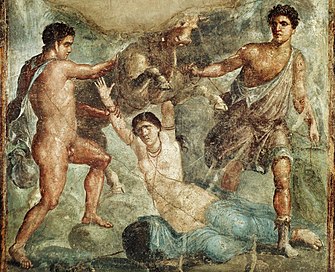

Preparation of an animal sacrifice; marble, fragment of an architectural relief, first quarter of the 2nd century CE; from Rome, Italian republic
The high number of Roman copies of Greek art as well speaks of the esteem Roman artists had for Greek art, and perhaps of its rarer and higher quality.[v] Many of the art forms and methods used by the Romans – such as high and low relief, complimentary-continuing sculpture, bronze casting, vase art, mosaic, cameo, coin fine art, fine jewelry and metalwork, funerary sculpture, perspective drawing, caricature, genre and portrait painting, landscape painting, architectural sculpture, and trompe-l'œil painting – all were adult or refined by Aboriginal Greek artists.[6] One exception is the Roman bust, which did not include the shoulders. The traditional caput-and-shoulders bust may have been an Etruscan or early on Roman course.[7] Virtually every artistic technique and method used by Renaissance artists ane,900 years later had been demonstrated by Ancient Greek artists, with the notable exceptions of oil colors and mathematically accurate perspective.[eight] Where Greek artists were highly revered in their society, about Roman artists were anonymous and considered tradesmen. In that location is no recording, every bit in Aboriginal Greece, of the great masters of Roman art, and practically no signed works. Where Greeks worshipped the artful qualities of great art, and wrote extensively on artistic theory, Roman art was more decorative and indicative of status and wealth, and patently not the subject field of scholars or philosophers.[nine]
Owing in role to the fact that the Roman cities were far larger than the Greek metropolis-states in power and population, and generally less provincial, art in Ancient Rome took on a wider, and sometimes more utilitarian, purpose. Roman culture assimilated many cultures and was for the most part tolerant of the ways of conquered peoples.[5] Roman art was commissioned, displayed, and owned in far greater quantities, and adapted to more uses than in Greek times. Wealthy Romans were more than materialistic; they decorated their walls with art, their abode with decorative objects, and themselves with fine jewelry.
In the Christian era of the late Empire, from 350 to 500 CE, wall painting, mosaic ceiling and floor work, and funerary sculpture thrived, while full-sized sculpture in the round and panel painting died out, most probable for religious reasons.[10] When Constantine moved the capital of the empire to Byzantium (renamed Constantinople), Roman fine art incorporated Eastern influences to produce the Byzantine style of the late empire. When Rome was sacked in the 5th century, artisans moved to and institute work in the Eastern upper-case letter. The Church of Hagia Sophia in Constantinople employed nearly ten,000 workmen and artisans, in a final burst of Roman art under Emperor Justinian (527–565 CE), who besides ordered the creation of the famous mosaics of Basilica of San Vitale in the metropolis of Ravenna.[eleven]
Painting [edit]
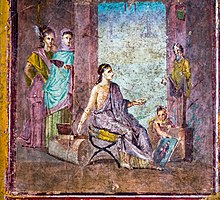
Female painter sitting on a campstool and painting a statue of Dionysus or Priapus onto a panel which is held by a boy. Fresco from Pompeii, 1st century
Of the vast trunk of Roman painting we now have only a very few pockets of survivals, with many documented types not surviving at all, or doing so only from the very end of the catamenia. The all-time known and most important pocket is the wall paintings from Pompeii, Herculaneum and other sites nearby, which testify how residents of a wealthy seaside resort decorated their walls in the century or then earlier the fatal eruption of Mount Vesuvius in 79 AD. A succession of dated styles have been defined and analysed past modernistic art historians start with August Mau, showing increasing elaboration and sophistication.
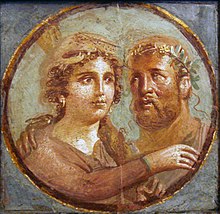
Starting in the 3rd century Advertisement and finishing by about 400 we have a big body of paintings from the Catacombs of Rome, past no ways all Christian, showing the afterward continuation of the domestic decorative tradition in a version adapted - probably not greatly adapted - for use in burial chambers, in what was probably a rather humbler social milieu than the largest houses in Pompeii. Much of Nero's palace in Rome, the Domus Aurea, survived equally grottos and gives the states examples which nosotros tin can be sure represent the very finest quality of wall-painting in its fashion, and which may well have represented significant innovation in style. There are a number of other parts of painted rooms surviving from Rome and elsewhere, which somewhat help to fill up in the gaps of our knowledge of wall-painting. From Roman Egypt there are a large number of what are known as Fayum mummy portraits, bosom portraits on wood added to the exterior of mummies by a Romanized heart class; despite their very distinct local character they are probably broadly representative of Roman style in painted portraits, which are otherwise entirely lost.
Nix remains of the Greek paintings imported to Rome during the 4th and 5th centuries, or of the painting on wood washed in Italy during that catamenia.[four] In sum, the range of samples is confined to only well-nigh 200 years out of the near 900 years of Roman history,[12] and of provincial and decorative painting. Most of this wall painting was done using the a secco (dry out) method, merely some fresco paintings as well existed in Roman times. At that place is bear witness from mosaics and a few inscriptions that some Roman paintings were adaptations or copies of before Greek works.[12] Nonetheless, adding to the confusion is the fact that inscriptions may be recording the names of immigrant Greek artists from Roman times, not from Ancient Greek originals that were copied.[viii] The Romans entirely lacked a tradition of figurative vase-painting comparable to that of the Ancient Greeks, which the Etruscans had emulated.
Variety of subjects [edit]

Roman painting provides a wide variety of themes: animals, still life, scenes from everyday life, portraits, and some mythological subjects. During the Hellenistic menstruation, information technology evoked the pleasures of the countryside and represented scenes of shepherds, herds, rustic temples, rural mountainous landscapes and country houses.[8] Erotic scenes are besides relatively common. In the late empire, after 200AD, early Christian themes mixed with heathen imagery survive on catacomb walls.[13]
Mural and vistas [edit]
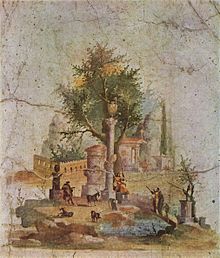
The main innovation of Roman painting compared to Greek art was the evolution of landscapes, in particular incorporating techniques of perspective, though truthful mathematical perspective adult i,500 years afterwards. Surface textures, shading, and coloration are well practical but scale and spatial depth was still non rendered accurately. Some landscapes were pure scenes of nature, especially gardens with flowers and copse, while others were architectural vistas depicting urban buildings. Other landscapes show episodes from mythology, the most famous demonstrating scenes from the Odyssey.[xiv]
In the cultural point of view, the fine art of the aboriginal Due east would have known mural painting just equally the backdrop to civil or military narrative scenes.[15] This theory is defended by Franz Wickhoff, is debatable. Information technology is possible to see evidence of Greek noesis of landscape portrayal in Plato's Critias (107b–108b):
... and if we look at the portraiture of divine and of human being bodies equally executed by painters, in respect of the ease or difficulty with which they succeed in imitating their subjects in the stance of onlookers, we shall notice in the first place that as regards the globe and mountains and rivers and forest and the whole of sky, with the things that exist and motion therein, we are content if a man is able to represent them with fifty-fifty a small degree of likeness ...[16]
Still life [edit]
Roman still life subjects are often placed in illusionist niches or shelves and depict a diversity of everyday objects including fruit, live and expressionless animals, seafood, and shells. Examples of the theme of the glass jar filled with h2o were skillfully painted and later served as models for the aforementioned discipline frequently painted during the Renaissance and Bizarre periods.[17]
Portraits [edit]
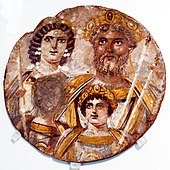
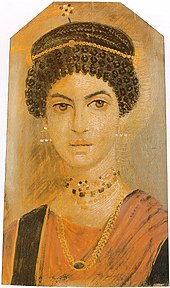
Pliny complained of the declining state of Roman portrait art, "The painting of portraits which used to transmit through the ages the accurate likenesses of people, has entirely gone out ... Indolence has destroyed the arts."[18] [19]
In Greece and Rome, wall painting was not considered as high art. The most prestigious form of art also sculpture was panel painting, i.due east. tempera or encaustic painting on wooden panels. Unfortunately, since woods is a perishable textile, just a very few examples of such paintings accept survived, namely the Severan Tondo from c. 200 Advertising, a very routine official portrait from some provincial government role, and the well-known Fayum mummy portraits, all from Roman Egypt, and near certainly not of the highest contemporary quality. The portraits were attached to burial mummies at the face up, from which about all have now been discrete. They usually depict a single person, showing the head, or head and upper chest, viewed frontally. The groundwork is ever monochrome, sometimes with decorative elements.[xx] In terms of artistic tradition, the images clearly derive more from Greco-Roman traditions than Egyptian ones. They are remarkably realistic, though variable in artistic quality, and may signal that similar art which was widespread elsewhere but did not survive. A few portraits painted on glass and medals from the afterward empire accept survived, as have coin portraits, some of which are considered very realistic as well.[21]
Gold glass [edit]

Golden glass, or gold sandwich drinking glass, was a technique for fixing a layer of golden leaf with a design between two fused layers of glass, developed in Hellenistic glass and revived in the 3rd century Advertizing. In that location are a very few big designs, including a very fine group of portraits from the 3rd century with added pigment, but the great bulk of the around 500 survivals are roundels that are the cut-off bottoms of wine cups or glasses used to mark and decorate graves in the Catacombs of Rome by pressing them into the mortar. They predominantly date from the quaternary and 5th centuries. Near are Christian, though there are many pagan and a few Jewish examples. It is likely that they were originally given as gifts on marriage, or festive occasions such as New year. Their iconography has been much studied, although artistically they are relatively unsophisticated.[23] Their subjects are similar to the crypt paintings, simply with a difference balance including more portraiture. As time went on there was an increase in the depiction of saints.[24] The same technique began to exist used for aureate tesserae for mosaics in the mid-1st century in Rome, and past the 5th century these had become the standard background for religious mosaics.
The earlier group are "amongst the nearly vivid portraits to survive from Early Christian times. They stare out at us with an extraordinary stern and melancholy intensity",[25] and represent the best surviving indications of what high quality Roman portraiture could achieve in paint. The Gennadios medallion in the Metropolitan Museum of Fine art in New York, is a fine example of an Alexandrian portrait on blue glass, using a rather more than circuitous technique and naturalistic manner than most Tardily Roman examples, including painting onto the gold to create shading, and with the Greek inscription showing local dialect features. He had peradventure been given or commissioned the piece to gloat victory in a musical competition.[26] One of the most famous Alexandrian-style portrait medallions, with an inscription in Egyptian Greek, was later mounted in an Early on Medieval crux gemmata in Brescia, in the mistaken belief that it showed the pious empress and Gothic queen Galla Placida and her children;[27] in fact the knot in the central effigy'southward dress may marker a devotee of Isis.[28] This is one of a group of 14 pieces dating to the tertiary century AD, all individualized secular portraits of high quality.[29] The inscription on the medallion is written in the Alexandrian dialect of Greek and hence most likely depicts a family from Roman Egypt.[30] The medallion has likewise been compared to other works of contemporaneous Roman-Egyptian artwork, such as the Fayum mummy portraits.[22] It is thought that the tiny item of pieces such every bit these can merely have been accomplished using lenses.[31] The afterward glasses from the catacombs have a level of portraiture that is rudimentary, with features, hairstyles and clothes all post-obit stereotypical styles.[32]
Genre scenes [edit]
Roman genre scenes by and large depict Romans at leisure and include gambling, music and sexual encounters.[ citation needed ] Some scenes depict gods and goddesses at leisure.[8] [12]
Triumphal paintings [edit]
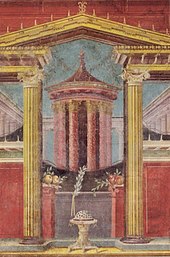

Roman fresco with a banquet scene from the Casa dei Casti Amanti, Pompeii
From the tertiary century BC, a specific genre known as Triumphal Paintings appeared, as indicated past Pliny (XXXV, 22).[33] These were paintings which showed triumphal entries after war machine victories, represented episodes from the war, and conquered regions and cities. Summary maps were drawn to highlight key points of the campaign. Josephus describes the painting executed on the occasion of Vespasian and Titus's sack of Jerusalem:
In that location was also wrought gold and ivory attached about them all; and many resemblances of the war, and those in several means, and variety of contrivances, affording a about lively portraiture of itself. For there was to be seen a happy country laid waste material, and entire squadrons of enemies slain; while some of them ran abroad, and some were carried into captivity; with walls of great altitude and magnitude overthrown and ruined by machines; with the strongest fortifications taken, and the walls of nearly populous cities upon the tops of hills seized on, and an army pouring itself within the walls; as also every identify full of slaughter, and supplications of the enemies, when they were no longer able to lift up their hands in manner of opposition. Fire also sent upon temples was here represented, and houses overthrown, and falling upon their owners: rivers also, later they came out of a large and melancholy desert, ran down, not into a land cultivated, nor equally beverage for men, or for cattle, but through a land still on fire upon every side; for the Jews related that such a matter they had undergone during this war. Now the workmanship of these representations was then magnificent and lively in the construction of the things, that information technology exhibited what had been done to such as did not see it, as if they had been there really present. On the top of every one of these pageants was placed the commander of the city that was taken, and the manner wherein he was taken.[34]
These paintings have disappeared, but they probable influenced the limerick of the historical reliefs carved on military sarcophagi, the Arch of Titus, and Trajan'due south Column. This evidence underscores the significance of landscape painting, which sometimes tended towards being perspective plans.
Ranuccio also describes the oldest painting to be establish in Rome, in a tomb on the Esquiline Hill:
Information technology describes a historical scene, on a clear background, painted in four superimposed sections. Several people are identified, such Marcus Fannius and Marcus Fabius. These are larger than the other figures ... In the 2d zone, to the left, is a city encircled with crenellated walls, in forepart of which is a large warrior equipped with an oval buckler and a feathered helmet; about him is a man in a curt tunic, armed with a spear...Around these 2 are smaller soldiers in short tunics, armed with spears...In the lower zone a battle is taking identify, where a warrior with oval buckler and a feathered helmet is shown larger than the others, whose weapons permit to assume that these are probably Samnites.
This episode is difficult to pinpoint. One of Ranuccio's hypotheses is that it refers to a victory of the consul Fabius Maximus Rullianus during the second war against Samnites in 326 BC. The presentation of the figures with sizes proportional to their importance is typically Roman, and finds itself in plebeian reliefs. This painting is in the infancy of triumphal painting, and would accept been achieved past the get-go of the 3rd century BC to decorate the tomb.
Sculpture [edit]

Early Roman art was influenced past the art of Greece and that of the neighbouring Etruscans, themselves greatly influenced by their Greek trading partners. An Etruscan speciality was near life size tomb effigies in terracotta, usually lying on meridian of a sarcophagus lid propped upward on one elbow in the pose of a diner in that catamenia. Equally the expanding Roman Republic began to conquer Greek territory, at first in Southern Italy and and then the entire Hellenistic globe except for the Parthian far eastward, official and patrician sculpture became largely an extension of the Hellenistic fashion, from which specifically Roman elements are hard to uncrease, particularly every bit so much Greek sculpture survives just in copies of the Roman menses.[35] By the 2nd century BC, "most of the sculptors working in Rome" were Greek,[36] often enslaved in conquests such as that of Corinth (146 BC), and sculptors continued to exist mostly Greeks, often slaves, whose names are very rarely recorded. Vast numbers of Greek statues were imported to Rome, whether as booty or the effect of extortion or commerce, and temples were often decorated with re-used Greek works.[37]
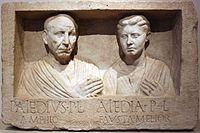
A native Italian mode tin can be seen in the tomb monuments of prosperous center-grade Romans, which very often featured portrait busts, and portraiture is arguably the main forcefulness of Roman sculpture. In that location are no survivals from the tradition of masks of ancestors that were worn in processions at the funerals of the corking families and otherwise displayed in the home, but many of the busts that survive must stand for bequeathed figures, perhaps from the big family tombs like the Tomb of the Scipios or the later on mausolea exterior the urban center. The famous bronze caput supposedly of Lucius Junius Brutus is very variously dated, but taken as a very rare survival of Italic manner nether the Commonwealth, in the preferred medium of bronze.[38] Similarly stern and forceful heads are seen in the coins of the consuls, and in the Regal period coins also equally busts sent around the Empire to exist placed in the basilicas of provincial cities were the main visual form of imperial propaganda; even Londinium had a near-jumbo statue of Nero, though far smaller than the 30-metre-high Colossus of Nero in Rome, now lost.[39] The Tomb of Eurysaces the Baker, a successful freedman (c. fifty-xx BC) has a frieze that is an unusually large example of the "plebeian" way.[40] Imperial portraiture was initially Hellenized and highly arcadian, every bit in the Blacas Cameo and other portraits of Augustus.

Arch of Constantine, 315: Hadrian king of beasts-hunting (left) and sacrificing (right), to a higher place a section of the Constantinian frieze, showing the contrast of styles.
The Romans did non generally endeavor to compete with costless-standing Greek works of heroic exploits from history or mythology, but from early on produced historical works in relief, culminating in the great Roman triumphal columns with continuous narrative reliefs winding around them, of which those commemorating Trajan (113 AD) and Marcus Aurelius (by 193) survive in Rome, where the Ara Pacis ("Altar of Peace", 13 BC) represents the official Greco-Roman style at its well-nigh classical and refined, and the Sperlonga sculptures it at its nigh baroque. Some late Roman public sculptures developed a massive, simplified style that sometimes anticipates Soviet socialist realism. Among other major examples are the earlier re-used reliefs on the Arch of Constantine and the base of the Column of Antoninus Pius (161),[41] Campana reliefs were cheaper pottery versions of marble reliefs and the sense of taste for relief was from the imperial flow expanded to the sarcophagus.
All forms of luxury minor sculpture continued to be patronized, and quality could be extremely loftier, equally in the silver Warren Loving cup, glass Lycurgus Cup, and large cameos like the Gemma Augustea, Gonzaga Cameo and the "Dandy Cameo of France".[42] For a much wider section of the population, moulded relief decoration of pottery vessels and small figurines were produced in not bad quantity and oft considerable quality.[43]
After moving through a late 2nd century "baroque" phase,[44] in the 3rd century, Roman fine art largely abandoned, or simply became unable to produce, sculpture in the classical tradition, a alter whose causes remain much discussed. Even the most of import imperial monuments now showed stumpy, large-eyed figures in a harsh frontal fashion, in simple compositions emphasizing ability at the expense of grace. The dissimilarity is famously illustrated in the Arch of Constantine of 315 in Rome, which combines sections in the new style with roundels in the earlier total Greco-Roman style taken from elsewhere, and the Four Tetrarchs (c. 305) from the new capital letter of Constantinople, now in Venice. Ernst Kitzinger found in both monuments the same "chubby proportions, angular movements, an ordering of parts through symmetry and repetition and a rendering of features and drapery folds through incisions rather than modelling... The hallmark of the style wherever it appears consists of an emphatic hardness, heaviness and angularity – in curt, an almost consummate rejection of the classical tradition".[45]
This revolution in way presently preceded the period in which Christianity was adopted by the Roman state and the great majority of the people, leading to the end of large religious sculpture, with big statues at present but used for emperors, as in the famous fragments of a colossal acrolithic statue of Constantine, and the 4th or 5th century Colossus of Barletta. Withal rich Christians continued to committee reliefs for sarcophagi, as in the Sarcophagus of Junius Bassus, and very small sculpture, specially in ivory, was continued by Christians, building on the fashion of the consular diptych.[46]
-

-

The Orator, c. 100 BC, an Etrusco-Roman bronze statue depicting Aule Metele (Latin: Aulus Metellus), an Etruscan man wearing a Roman toga while engaged in rhetoric; the statue features an inscription in the Etruscan alphabet
-
-

-

Tomb relief of the Decii, 98–117 Advertising
-

Portrait Bust of a Man, Aboriginal Rome, 60 BC

Traditional Roman sculpture is divided into v categories: portraiture, historical relief, funerary reliefs, sarcophagi, and copies of aboriginal Greek works.[49] Opposite to the belief of early archaeologists, many of these sculptures were large polychrome terra-cotta images, such as the Apollo of Veii (Villa Givlia, Rome), just the painted surface of many of them has worn away with time.
Narrative reliefs [edit]
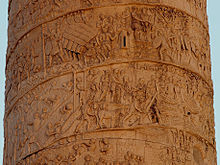
While Greek sculptors traditionally illustrated military exploits through the utilize of mythological allegory, the Romans used a more documentary way. Roman reliefs of battle scenes, similar those on the Column of Trajan, were created for the glorification of Roman might, but likewise provide first-hand representation of war machine costumes and military equipment. Trajan's cavalcade records the various Dacian wars conducted by Trajan in what is modern solar day Romania. It is the foremost case of Roman historical relief and i of the great artistic treasures of the ancient world. This unprecedented accomplishment, over 650 foot of spiraling length, presents non just realistically rendered individuals (over two,500 of them), but landscapes, animals, ships, and other elements in a continuous visual history – in effect an aboriginal precursor of a documentary movie. It survived destruction when information technology was adapted as a base for Christian sculpture.[fifty] During the Christian era later on 300 Advertizement, the decoration of door panels and sarcophagi connected but full-sized sculpture died out and did non appear to be an important element in early churches.[10]
Minor arts [edit]

Pottery and terracottas [edit]
The Romans inherited a tradition of art in a broad range of the and so-chosen "minor arts" or decorative art. Well-nigh of these flourished about impressively at the luxury level, but large numbers of terracotta figurines, both religious and secular, connected to be produced cheaply, every bit well as some larger Campana reliefs in terracotta.[51] Roman fine art did not use vase-painting in the manner of the ancient Greeks, but vessels in Ancient Roman pottery were often stylishly decorated in moulded relief.[52] Producers of the millions of minor oil lamps sold seem to have relied on attractive decoration to beat competitors and every field of study of Roman fine art except mural and portraiture is found on them in miniature.[53]
Glass [edit]
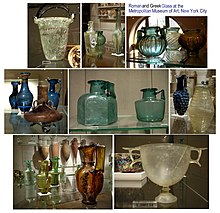
Luxury arts included fancy Roman glass in a great range of techniques, many smaller types of which were probably affordable to a good proportion of the Roman public. This was certainly not the case for the most extravagant types of glass, such every bit the cage cups or diatreta, of which the Lycurgus Cup in the British Museum is a near-unique figurative instance in glass that changes color when seen with light passing through it. The Augustan Portland Vase is the masterpiece of Roman cameo glass,[54] and imitated the style of the big engraved gems (Blacas Cameo, Gemma Augustea, Bully Cameo of France) and other hardstone carvings that were besides almost popular around this time.[55]
Mosaic [edit]

Roman mosaic was a minor art, though frequently on a very large scale, until the very stop of the period, when late-quaternary-century Christians began to use it for big religious images on walls in their new large churches; in before Roman art mosaic was mainly used for floors, curved ceilings, and within and outside walls that were going to become moisture. The famous copy of a Hellenistic painting in the Alexander Mosaic in Naples was originally placed in a floor in Pompeii; this is much higher quality work than most Roman mosaic, though very fine panels, oftentimes of withal life subjects in modest or micromosaic tesserae take besides survived. The Romans distinguished between normal opus tessellatum with tesserae mostly over iv mm beyond, which was laid downwardly on site, and effectively opus vermiculatum for small panels, which is idea to take been produced offsite in a workshop, and brought to the site as a finished panel. The latter was a Hellenistic genre which is found in Italian republic between nigh 100 BC and 100 Advertising. Most signed mosaics take Greek names, suggesting the artists remained more often than not Greek, though probably oft slaves trained up in workshops. The late 2nd century BC Nile mosaic of Palestrina is a very large example of the popular genre of Nilotic landscape, while the 4th century Gladiator Mosaic in Rome shows several large figures in combat.[56] Orpheus mosaics, often very large, were another favourite subject for villas, with several ferocious animals tamed by Orpheus'southward playing music. In the transition to Byzantine art, hunting scenes tended to take over big animal scenes.
Metalwork [edit]
Metalwork was highly adult, and conspicuously an essential function of the homes of the rich, who dined off silver, while often drinking from drinking glass, and had elaborate bandage fittings on their piece of furniture, jewellery, and pocket-sized figurines. A number of important hoards institute in the concluding 200 years, generally from the more violent edges of the late empire, take given us a much clearer idea of Roman silver plate. The Mildenhall Treasure and Hoxne Hoard are both from East Anglia in England.[57] At that place are few survivals of upmarket ancient Roman piece of furniture, only these show refined and elegant blueprint and execution.
Coins and medals [edit]

Hadrian, with "RESTITVTORI ACHAIAE" on the contrary, jubilant his spending in Achaia (Greece), and showing the quality of ordinary bronze coins that were used by the mass population, hence the wear on higher areas.
Few Roman coins achieve the artistic peaks of the best Greek coins, but they survive in vast numbers and their iconography and inscriptions class a crucial source for the study of Roman history, and the development of regal iconography, besides as containing many fine examples of portraiture. They penetrated to the rural population of the whole Empire and beyond, with barbarians on the fringes of the Empire making their own copies. In the Empire medallions in precious metals began to be produced in small-scale editions as imperial gifts, which are similar to coins, though larger and normally effectively in execution. Images in coins initially followed Greek styles, with gods and symbols, but in the death throes of the Democracy kickoff Pompey and then Julius Caesar appeared on coins, and portraits of the emperor or members of his family unit became standard on imperial coinage. The inscriptions were used for propaganda, and in the later Empire the army joined the emperor as the beneficiary.
Architecture [edit]
Information technology was in the area of architecture that Roman art produced its greatest innovations. Because the Roman Empire extended over so neat of an area and included so many urbanized areas, Roman engineers developed methods for citybuilding on a grand calibration, including the use of concrete. Massive buildings similar the Pantheon and the Colosseum could never take been constructed with previous materials and methods. Though concrete had been invented a k years earlier in the Virtually Eastward, the Romans extended its use from fortifications to their most impressive buildings and monuments, capitalizing on the fabric's force and low cost.[58] The concrete core was covered with a plaster, brick, stone, or marble veneer, and decorative polychrome and gold-gilded sculpture was often added to produce a dazzling effect of ability and wealth.[58]
Because of these methods, Roman architecture is legendary for the durability of its construction; with many buildings still standing, and some still in utilize, mostly buildings converted to churches during the Christian era. Many ruins, yet, have been stripped of their marble veneer and are left with their concrete cadre exposed, thus appearing somewhat reduced in size and grandeur from their original appearance, such as with the Basilica of Constantine.[59]
During the Republican era, Roman architecture combined Greek and Etruscan elements, and produced innovations such as the round temple and the curved arch.[60] As Roman power grew in the early empire, the first emperors inaugurated wholesale leveling of slums to build grand palaces on the Palatine Hill and nearby areas, which required advances in engineering science methods and big scale pattern. Roman buildings were then built in the commercial, political, and social grouping known as a forum, that of Julius Caesar beingness the commencement and several added later, with the Forum Romanum being the most famous. The greatest arena in the Roman world, the Colosseum, was completed around 80 AD at the far terminate of that forum. It held over 50,000 spectators, had retractable cloth coverings for shade, and could stage massive spectacles including huge gladiatorial contests and mock naval battles. This masterpiece of Roman architecture epitomizes Roman technology efficiency and incorporates all three architectural orders – Doric, Ionic, and Corinthian.[61] Less historic but just every bit important if not more so for about Roman citizens, was the five-story insula or city block, the Roman equivalent of an apartment building, which housed tens of thousands of Romans.[62]

It was during the reign of Trajan (98–117 Advert) and Hadrian (117–138 AD) that the Roman Empire reached its greatest extent and that Rome itself was at the peak of its artistic glory – achieved through massive edifice programs of monuments, meeting houses, gardens, aqueducts, baths, palaces, pavilions, sarcophagi, and temples.[l] The Roman apply of the arch, the use of concrete edifice methods, the use of the dome all permitted structure of vaulted ceilings and enabled the building of these public spaces and complexes, including the palaces, public baths and basilicas of the "Golden Age" of the empire. Outstanding examples of dome construction include the Pantheon, the Baths of Diocletian, and the Baths of Caracalla. The Pantheon (defended to all the planetary gods) is the best preserved temple of ancient times with an intact ceiling featuring an open "eye" in the heart. The height of the ceiling exactly equals the interior radius of the building, creating a hemispherical enclosure.[59] These 1000 buildings later served as inspirational models for architects of the Italian Renaissance, such as Brunelleschi. By the age of Constantine (306-337 Advertising), the final great building programs in Rome took place, including the erection of the Arch of Constantine built about the Colosseum, which recycled some stone work from the forum nearby, to produce an eclectic mix of styles.[13]
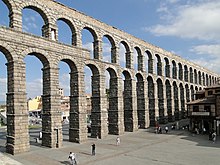
Roman aqueducts, also based on the arch, were commonplace in the empire and essential transporters of water to big urban areas. Their standing masonry remains are peculiarly impressive, such as the Pont du Gard (featuring 3 tiers of arches) and the aqueduct of Segovia, serving as mute testimony to their quality of their design and construction.[61]
See also [edit]
- Bacchic art
- Byzantine fine art
- Erotic art in Pompeii and Herculaneum
- Latin literature
- Music of ancient Rome
- Neoclassicism
- Parthian art
- Pompeian Styles
- Roman graffiti
References [edit]
Citations [edit]
- ^ Toynbee, J. Thou. C. (1971). "Roman Art". The Classical Review. 21 (3): 439–442. doi:10.1017/S0009840X00221331. JSTOR 708631.
- ^ Sybille Ebert-Schifferer, Withal Life: A History, Harry N. Abrams, New York, 1998, p. xv, ISBN 0-8109-4190-2
- ^ Ebert-Schifferer, p. 16
- ^ a b Piper, p. 252
- ^ a b c Janson, p. 158
- ^ Piper, p. 248–253
- ^ Piper, p. 255
- ^ a b c d Piper, p. 253
- ^ Piper, p. 254
- ^ a b Piper, p. 261
- ^ Piper, p. 266
- ^ a b c Janson, p. 190
- ^ a b Piper, p. 260
- ^ Janson, p. 191
- ^ according to Ernst Gombrich.
- ^ Plato. Critias (107b–108b), trans W.R.K. Lamb 1925. at the Perseus Project accessed 27 June 2006
- ^ Janson, p. 192
- ^ John Hope-Hennessy, The Portrait in the Renaissance, Bollingen Foundation, New York, 1966, pp. 71–72
- ^ Pliny the Elder, Natural History XXXV:ii trans H. Rackham 1952. Loeb Classical Library
- ^ Janson, p. 194
- ^ Janson, p. 195
- ^ a b Daniel Thomas Howells (2015). "A Catalogue of the Late Antique Gold Drinking glass in the British Museum (PDF)." London: the British Museum (Arts and Humanities Enquiry Quango). Accessed two Oct 2016, p. vii: "Other of import contributions to scholarship included the publication of an extensive summary of gold drinking glass scholarship under the entry 'Fonds de coupes' in Fernand Cabrol and Henri Leclercq's comprehensive Dictionnaire d'archéologie chrétienne et de liturgie in 1923. Leclercq updated Vopel'southward catalogue, recording 512 gilt spectacles considered to be 18-carat, and developed a typological series consisting of eleven iconographic subjects: biblical subjects; Christ and the saints; diverse legends; inscriptions; heathen deities; secular subjects; male person portraits; female portraits; portraits of couples and families; animals; and Jewish symbols. In a 1926 commodity devoted to the brushed technique gold glass known equally the Brescia medallion (Pl. ane), Fernand de Mély challenged the deeply ingrained opinion of Garrucci and Vopel that all examples of brushed technique golden glass were in fact forgeries. The following twelvemonth, de Mély'southward hypothesis was supported and further elaborated upon in 2 articles past different scholars. A case for the Brescia medallion's authenticity was argued for, not on the basis of its iconographic and orthographic similarity with pieces from Rome (a key reason for Garrucci'due south dismissal), only instead for its close similarity to the Fayoum mummy portraits from Egypt. Indeed, this comparison was given further credence by Walter Crum's exclamation that the Greek inscription on the medallion was written in the Alexandrian dialect of Arab republic of egypt. De Mély noted that the medallion and its inscription had been reported equally early on equally 1725, far too early on for the idiosyncrasies of Graeco-Egyptian word endings to have been understood by forgers." "Comparing the iconography of the Brescia medallion with other more than closely dated objects from Egypt, Hayford Peirce then proposed that brushed technique medallions were produced in the early tertiary century, whilst de Mély himself advocated a more general 3rd-century date. With the actuality of the medallion more firmly established, Joseph Breck was prepared to propose a tardily tertiary to early 4th century date for all of the brushed technique cobalt blue-backed portrait medallions, some of which also had Greek inscriptions in the Alexandrian dialect. Although considered genuine past the majority of scholars by this betoken, the unequivocal actuality of these spectacles was not fully established until 1941 when Gerhart Ladner discovered and published a photo of i such medallion nonetheless in situ, where it remains to this day, impressed into the plaster sealing in an individual loculus in the Catacomb of Panfilo in Rome (Pl. 2). Soon after in 1942, Morey used the phrase 'brushed technique' to categorize this gilt glass blazon, the iconography beingness produced through a series of small incisions undertaken with a precious stone cutter'south precision and lending themselves to a chiaroscuro-like effect like to that of a fine steel engraving simulating castor strokes."
- ^ Beckwith, 25-26,
- ^ Grig, throughout
- ^ Honour and Fleming, Pt ii, "The Catacombs" at illustration 7.7
- ^ Weitzmann, no. 264, entry by J.D.B.; run across besides no. 265; Medallion with a Portrait of Gennadios, Metropolitan Museum of Art, with better prototype.
- ^ Boardman, 338-340; Beckwith, 25
- ^ Vickers, 611
- ^ Grig, 207
- ^ Jás Elsner (2007). "The Changing Nature of Roman Fine art and the Art Historical Problem of Manner," in Eva R. Hoffman (ed), Tardily Antique and Medieval Fine art of the Medieval World, eleven-xviii. Oxford, Malden & Carlton: Blackwell Publishing. ISBN 978-1-4051-2071-v, p. 17, Figure 1.3 on p. xviii.
- ^ Sines and Sakellarakis, 194-195
- ^ Grig, 207; Lutraan, 29-45 goes into considerable particular
- ^ Natural History (Pliny) online at the Perseus Project
- ^ Josephus, The Jewish Wars Seven, 143-152 (Ch 6 Para 5). Trans. William Whiston Online accessed 27 June 2006
- ^ Strong, 58–63; Henig, 66-69
- ^ Henig, 24
- ^ Henig, 66–69; Strong, 36–39, 48; At the trial of Verres, former governor of Sicily, Cicero's prosecution details his depredations of art collections at great length.
- ^ Henig, 23–24
- ^ Henig, 66–71
- ^ Henig, 66; Stiff, 125
- ^ Henig, 73–82;Strong, 48–52, 80–83, 108–117, 128–132, 141–159, 177–182, 197–211
- ^ Henig, Affiliate six; Stiff, 303–315
- ^ Henig, Chapter eight
- ^ Stiff, 171–176, 211–214
- ^ Kitzinger, 9 (both quotes), more generally his Ch ane; Strong, 250–257, 264–266, 272–280
- ^ Strong, 287–291, 305–308, 315–318; Henig, 234–240
- ^ D.B. Saddington (2011) [2007]. "the Evolution of the Roman Imperial Fleets," in Paul Erdkamp (ed), A Companion to the Roman Army, 201-217. Malden, Oxford, Chichester: Wiley-Blackwell. ISBN 978-ane-4051-2153-8. Plate 12.two on p. 204.
- ^ Coarelli, Filippo (1987), I Santuari del Lazio in età repubblicana. NIS, Rome, pp 35-84.
- ^ Gazda, Elaine K. (1995). "Roman Sculpture and the Ethos of Emulation: Reconsidering Repetition". Harvard Studies in Classical Philology. Section of the Classics, Harvard Academy. 97 (Greece in Rome: Influence, Integration, Resistance): 121–156. doi:10.2307/311303. JSTOR 311303.
According to traditional art-historical taxonomy, Roman sculpture is divided into a number of singled-out categories--portraiture, historical relief, funerary reliefs, sarcophagi, and copies.
- ^ a b Piper, p. 256
- ^ Henig, 191-199
- ^ Henig, 179-187
- ^ Henig, 200-204
- ^ Henig, 215-218
- ^ Henig, 152-158
- ^ Henig, 116-138
- ^ Henig, 140-150; jewellery, 158-160
- ^ a b Janson, p. 160
- ^ a b Janson, p. 165
- ^ Janson, p. 159
- ^ a b Janson, p. 162
- ^ Janson, p. 167
Sources [edit]
- Beckwith, John. Early on Christian and Byzantine Fine art. Harmondsworth: Penguin, 1970.
- Boardman, John, The Oxford History of Classical Fine art. Oxford: Oxford University Press, 1993.
- Grig, Lucy. "Portraits, pontiffs and the Christianization of fourth-century Rome." Papers of the British School at Rome 72 (2004): 203-379.
- --. Roman Fine art, Religion and Society: New Studies From the Roman Art Seminar, Oxford 2005. Oxford: Archaeopress, 2006.
- Janson, H. West., and Anthony F Janson. History of Art. 6th ed. New York: Harry N. Abrams, 2001.
- Kitzinger, Ernst. Byzantine Fine art In the Making: Master Lines of Stylistic Evolution In Mediterranean Fine art, tertiary-7th Century. Cambridge: Harvard University Press, 1995.
- Henig, Martin. A Handbook of Roman Fine art: A Comprehensive Survey of All the Arts of the Roman World. Ithaca: Cornell Academy Press, 1983.
- Piper, David. The Illustrated Library of Art, Portland Business firm, New York, 1986, ISBN 0-517-62336-vi
- Strong, Donald Emrys, J. M. C Toynbee, and Roger Ling. Roman Art. 2nd ed. Harmondsworth, Middlesex: Penguin, 1988.
Further reading [edit]
- Andreae, Bernard. The Art of Rome. New York: H. N. Abrams, 1977.
- Beard, Mary, and John Henderson. Classical Art: From Greece to Rome. Oxford: Oxford Academy Press, 2001.
- Bianchi Bandinelli, Ranuccio. Rome, the Center of Power: 500 B.C. to A.D. 200. New York: G. Braziller, 1970.
- Borg, Barbara. A Companion to Roman Fine art. Chichester, Due west Sussex: John Wiley & Sons, 2015.
- Bright, Richard. Roman Fine art From the Republic to Constantine. Newton Abbot, Devon: Phaidon Press, 1974.
- D'Ambra, Eve. Art and Identity in the Roman Earth. London: Weidenfeld & Nicolson, 1998.
- --. Roman Fine art. Cambridge: Cambridge University Printing, 1998.
- Kleiner, Fred S. A History of Roman Fine art. Belmont, CA: Thomson/Wadsworth, 2007.
- Ramage, Nancy H. Roman Fine art: Romulus to Constantine. 6th ed. Upper Saddle River, NJ : Pearson, 2015.
- Stewart, Peter. Roman Art. Oxford: Oxford University Press, 2004.
- Syndicus, Eduard. Early on Christian Art. 1st ed. New York: Hawthorn Books, 1962.
- Tuck, Steven L. A History of Roman Art. Malden: Wiley Blackwell, 2015.
- Zanker, Paul. Roman Fine art. Los Angeles: J. Paul Getty Museum, 2010.
External links [edit]
- Roman Art - World History Encyclopedia
- Ancient Rome Art History Resources
- Dissolution and Becoming in Roman Wall-Painting
Source: https://en.wikipedia.org/wiki/Roman_art
0 Response to "How Are Ancient Romes Structures and Values Represented in Their Art and Architecture"
Postar um comentário